
Integrative Psychotherapist

When Words Aren't Enough: How Expressive Arts Therapy Can Help
When words cannot quite capture what you are feeling, creativity can offer another way in. Expressive arts therapy uses art, movement, imagery, writing and other forms of expression to explore emotions and experiences — and this work can be surprisingly powerful online. Find out more with Integrative Therapist, Calista Goh-Therond.
Sometimes, words are simply not enough.
We may know that something hurts without knowing how to explain it. We may understand our childhood intellectually yet find ourselves repeating the same relationship patterns. We may feel grief, anger, anxiety or loneliness somewhere in our bodies long before we can construct a sentence around it.
Expressive arts therapy offers another way to explore these experiences.
Rather than relying solely on conversation, expressive arts therapies use creativity, imagination, movement and symbolic expression as part of the therapeutic process. Depending on the therapist's training and the client's needs, sessions may incorporate drawing, painting, movement, music, drama, storytelling, poetry, imagery, objects, role-play or creative writing.
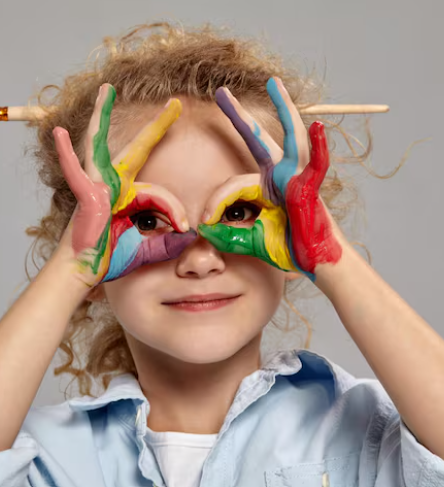
And importantly, you do not need to be artistic.
The purpose is not to create beautiful art.
The purpose is to communicate.
What Is Expressive Arts Therapy?
Expressive arts therapy is based on a deceptively simple idea: human beings communicate in many more ways than through language.
Before children can speak, they move, play, make sounds, gesture and create. Across cultures, humans have long used music, dance, ritual, storytelling and images to express experiences that words alone struggle to contain.
Therapy can intentionally work with these natural forms of expression.
You might draw what anxiety feels like rather than describe it.
You might use two chairs to explore an unresolved conversation.
You might create an image representing your younger self.
You might move your body in response to an emotion, write a letter you never intend to send, arrange objects to represent your family relationships, or use metaphor to explore a difficult decision.
The artwork is not the goal.
The process is the therapy.
Why Can Expressive Arts Therapy Be So Powerful?

Talk therapy often asks us to translate our experiences into language. But not every experience was originally encoded in words.
This can be particularly relevant when exploring early childhood experiences, trauma, grief and complicated emotional states. Sometimes we can explain something perfectly and still feel unchanged.
Expressive approaches create another pathway.
A person describing their family might say:
"My childhood was fine."
Yet when invited to place objects representing family members, they may instinctively place themselves far away from everyone else.
Suddenly, there is something to explore.
"I didn't realise how alone I felt."
The creative process can make the invisible visible. It can give shape to emotions, relationships and experiences that may have been difficult to reach through analysis alone.
Rather than requiring us to immediately explain what we feel, expressive arts therapy can allow us to encounter the experience first — and find meaning afterwards.
Does a Therapist Interpret Your Art?
One common misconception about expressive arts therapy is that the therapist looks at your drawing and announces what it "means."
A tree means this.
Red means anger.
A small figure means insecurity.
Good expressive arts therapy is generally much more collaborative and curious than this.
Rather than telling you what your creation means, a therapist might ask:
"What do you notice when you look at this?"
"Which part draws your attention?"
"If this image could speak, what might it say?"
The meaning belongs primarily to the person who created it.
The therapist helps create the conditions in which that meaning can emerge.
This can be deeply empowering. Instead of positioning the therapist as the expert on your inner world, therapist and client become curious about it together.
Can Expressive Arts Therapy Work Online?
People sometimes imagine that expressive arts therapy requires an elaborate studio filled with paints, musical instruments and costumes.
It doesn't.
Online expressive arts therapy can be surprisingly rich.
A therapist may invite you to bring simple materials such as paper, pens, coloured pencils, magazines, clay or objects already available around your home.
During an online session, you might:
draw or paint
move
write
create a collage
choose an object that represents an emotion
use cushions or chairs to represent different relationships
experiment with an empty-chair dialogue
explore imagery or metaphor
create something privately and decide how much — or how little — you want to share
The therapist remains present throughout, helping you notice emotions, bodily sensations, associations and meanings that emerge.
The screen does not necessarily have to become a barrier.
It can become a window into therapeutic work happening within your own environment.
Could Online Expressive Arts Therapy Actually Have Advantages?
For some people, yes.
Online therapy is sometimes described as a compromise: something we use when face-to-face therapy isn't available.
But for certain clients and certain kinds of therapeutic work, being at home can offer unique possibilities.
Your environment becomes part of the therapy

At home, you have access to objects, photographs, clothing, journals and meaningful possessions from your actual life.
Something unexpected can become therapeutic material.
"Find something in your room that represents how you feel right now."
Suddenly, an ordinary stone, photograph or childhood object can become a doorway into a conversation. In my online work, I have found that being in a client's own space can sometimes open possibilities that would not arise in a therapy room. A client may reach for an object, photograph or possession almost instinctively, without initially knowing why it feels significant. Becoming curious about that choice together can reveal emotions, memories or associations that a direct question may not have reached.
You control your creative space
Some people feel self-conscious creating while another person physically watches them.
Online, the therapist can remain present without hovering over the process. That additional psychological space may support experimentation and vulnerability.
You can also decide whether you want to show what you have created. Sometimes the process itself is more important than displaying the finished piece.
You can regulate your environment
You can choose your chair, lighting, blanket, favourite drink or familiar surroundings.
For people who feel anxious in unfamiliar clinical environments, working from a familiar space may help them settle into the therapeutic process.
Specialist therapy becomes more accessible
Online therapy can remove geographical barriers and reduce travel time, making specialist therapeutic approaches available to people who may struggle to find appropriately trained practitioners locally.
This can be particularly useful for people living overseas, travelling frequently, relocating between countries, or managing demanding work, caregiving or family schedules.
Online therapy is therefore not necessarily simply "face-to-face therapy through a computer."
It can become its own therapeutic environment.
Why Training in Expressive Arts Therapy Matters
There is an important distinction between creative activities that feel therapeutic and expressive arts therapy.
Colouring, journaling, dancing, painting and crafting can all be regulating, enjoyable and meaningful.
But something being therapeutic does not automatically make it therapy.
Creative work can unexpectedly bring powerful memories, grief, trauma, shame or previously avoided emotions to the surface. A trained therapist needs to understand not only how to facilitate an exercise, but also when not to pursue something further.
They need to recognise overwhelm, establish appropriate boundaries, work within their competence and help clients regain emotional stability when difficult material emerges.
Professional expressive arts training therefore involves much more than knowing creative exercises.
When choosing an expressive arts therapist, you may want to ask about:
their psychotherapy or mental-health qualifications
their specific training in expressive or creative arts therapies
professional registration or accreditation relevant to their country
supervised clinical experience
experience working with your particular concerns
how confidentiality and safety are managed during online sessions
A short creative workshop is not equivalent to clinical training.
And ultimately, the therapeutic relationship matters just as much as the technique.
Do I Need to Be Artistic for Expressive Arts Therapy?
Perhaps one of the greatest barriers to trying expressive arts therapy is the thought:
"But I'm not artistic."
You don't need to be.
There are no grades.
No auditions.
No correct drawings.
No expectation that anyone else will ever see what you create.
A stick figure can carry enormous meaning.
Three lines on a piece of paper can open an hour of conversation.
A movement lasting five seconds can sometimes reveal something that words have struggled to reach.
Expressive arts therapy invites us away from performance and towards curiosity.
The question is not, "Is this good?"
It is, "What am I noticing?"
I often find that the simplest creations can become the most meaningful. What matters is rarely how technically accomplished something is, but what the person notices while making it, how they respond to what appears, and what begins to emerge when we become curious about it together.
Who Might Expressive Arts Therapy Help?
People seek expressive arts therapy for many different reasons. It may be particularly worth exploring if you find yourself thinking:
"I know why I feel this way, but knowing hasn't changed it."
"I can't find the words for what happened."
"I spend so much time analysing my feelings that I don't know how to actually feel them."
"Talking about the same thing over and over doesn't seem to get me anywhere."
"I understand my patterns intellectually, but I keep repeating them."
Expressive approaches may be incorporated into therapeutic work involving anxiety, grief, relationship difficulties, life transitions, identity, trauma, stress and other emotional experiences.
The approach is not necessarily about replacing conversation. Often, words and creative expression work alongside one another.
Something is created.
Something is noticed.
And then perhaps something can finally be spoken.
When Words Are Not Enough
We spend much of adulthood trying to understand ourselves through thinking.
Sometimes healing requires another language.
A colour.
A movement.
A character.
A story.
An image.
A metaphor.
A piece of music.
An empty chair.
Expressive arts therapies remind us that we are more than thinking minds. We are imaginative, embodied, relational and creative beings.
Whether sitting together in a therapy room or meeting through a screen from opposite sides of the world, the invitation remains the same:
You don't always have to find the right words.
Sometimes you can begin by creating something — and discover what it has been trying to tell you.
If you are curious about expressive arts therapy or wondering whether an online approach might suit you, counselling can begin with a conversation about what you are experiencing and what way of working feels most comfortable for you.
Exploring Expressive Arts Therapy
If talking alone has not quite helped you reach what you are feeling, expressive arts therapy can offer another way to explore your experiences.
I integrates expressive and creative approaches into my therapeutic work and offers online counselling, allowing you to explore this way of working from your own space. Book an online session with me now!
Related Articles
Complex PTSD (C-PTSD): Symptoms, Causes, Signs and How Healing Is Possible
Using EMDR to Become Unstuck: How EMDR Therapy Helps Heal Anxiety, Trauma & Emotional Blocks